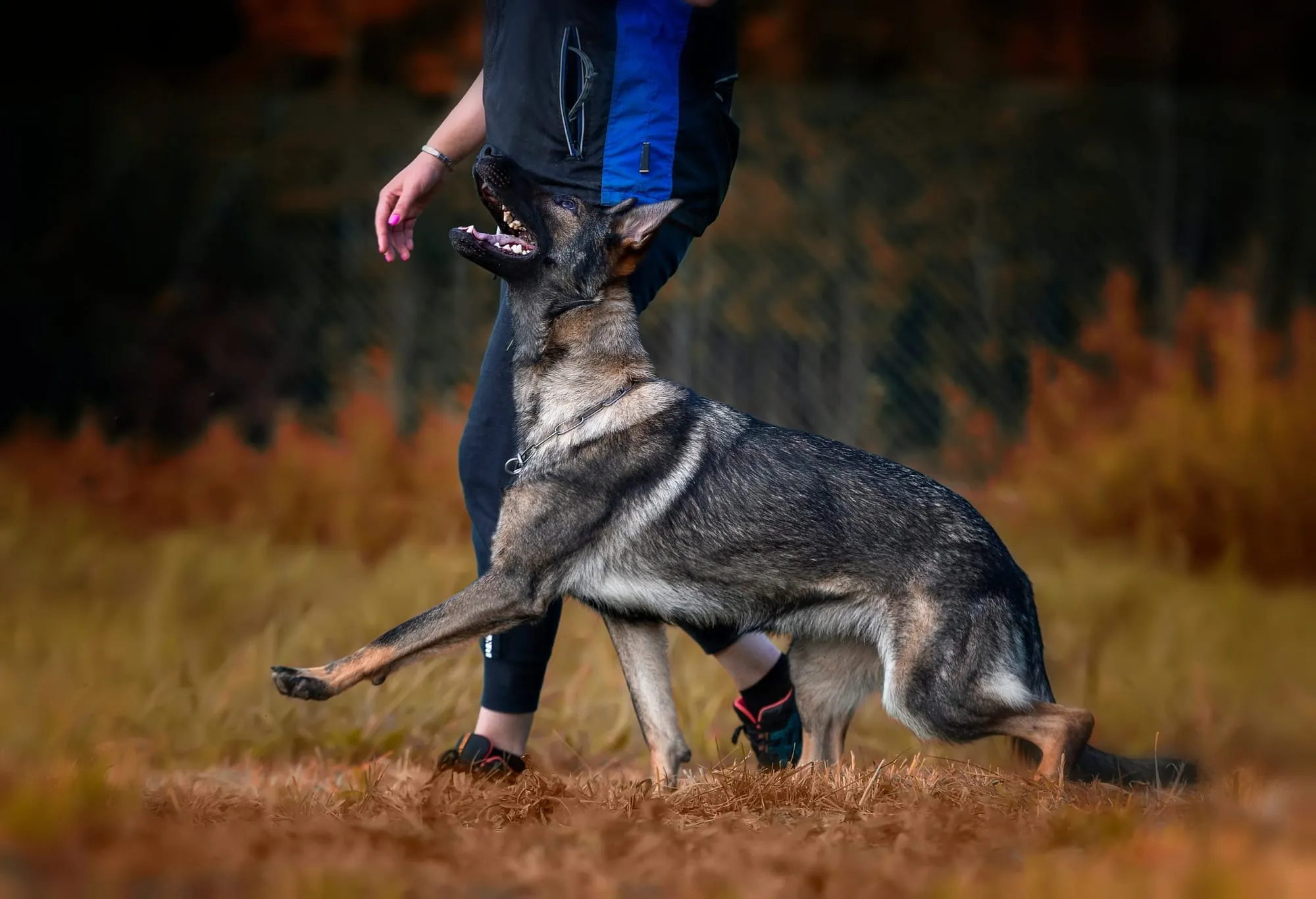
German Shepherd heeling with full focus on the handler

Education & Understanding

Training Insights: What Research Says About How Dogs Learn

Not tips. Not tricks. Ten findings from published research that explain why structure, communication, and leadership work, and what they mean for you and your dog.

Understand Your Dog Before You Train Them

MK9 is built on three principles: structure, communication, and leadership. We don't expect you to take those on faith.

Every insight below comes from peer-reviewed research or a veterinary behavior organization, and every source is linked at the bottom of the page. For each one, we explain what it found, what it means for you, and how it connects to the way MK9 trains.

By the Numbers

  • 72.5%of 13,700 pet dogs showed at least one problematic anxiety-related behavior[1]
  • 40%of dogs surrendered to 12 U.S. shelters had at least one behavioral reason[2]
  • 1 in 3referred behavior cases involve a painful condition, by a conservative estimate[3]
  • 72%of children bitten in one study knew the dog that bit them[4]
01

Structure

Clear rules. Predictable outcomes. Calm repetition.

  1. 01Structure

    Consistency Is the Most Powerful Tool You Own

    In a survey of 1,276 dog owners, more consistent owner behavior went with better obedience, and more time spent training and playing together went with a more obedient dog.[5]

    What it means
    When the rules change depending on who's home or what mood you're in, your dog has to guess. Guessing looks like disobedience.
    How MK9 applies it
    This is why structure comes first at MK9. Clear rules everyone in the house follows give your dog something reliable to learn.

  2. 02Structure

    Calm Structure Beats Harsh Correction and Permissiveness

    The same survey linked frequent punishment to more aggression and excitability. Rewarding unwanted behavior was linked to more aggression and excitability too.[5] In a separate study of 92 dogs at seven training schools, dogs trained mainly with aversive methods showed more stress behaviors during training and more "pessimistic" responses in a test afterward.[6]

    What it means
    Harshness and permissiveness both backfire. What works is clarity: calm, predictable responses that don't change with emotion.
    How MK9 applies it
    MK9 asks owners to lead with calm authority, and to build structure that doesn't change with emotion.
  3. 03Structure

    Short, Spaced Sessions Beat Marathons

    In a controlled study, dogs trained once or twice a week learned a new task faster than dogs trained every day, and one session a day beat three sessions back to back. All groups still remembered the task four weeks later.[7]

    What it means
    More isn't always better. Short, regular practice spread over time builds learning that lasts.
    How MK9 applies it
    Calm repetition is part of MK9's definition of structure, and Monthly Group Tune-Ups keep skills sharp after the program ends.
02

Communication

Dogs respond to what they understand.

  1. 04Communication

    One Second Can Change What Your Dog Learns

    In a study of how dogs learn, 60% of dogs learned the task when the reward came immediately. When the reward came just one second late, only 25% learned it.[8]

    What it means
    Your dog connects the result to whatever they were doing at that moment. Late feedback teaches the wrong lesson, or nothing at all.
    How MK9 applies it
    MK9 teaches owners to communicate with consistency, timing, and control. Timing is a skill you can learn.
  2. 05Communication

    Your Dog Is Reading You All the Time

    Research shows domestic dogs are unusually skilled at reading human social and communicative behavior, such as following a pointing gesture, even more so than chimpanzees.[9]

    What it means
    Your posture, hands, and tension send messages whether you intend them or not. Mixed signals create a confused dog.
    How MK9 applies it
    This is why MK9 trains the owner, not just the dog. The dog learns the commands. The owner learns how to lead.
  3. 06Communication

    Fear and Anxiety Are Common, and They Drive Behavior

    In a study of 13,700 dogs, 72.5% showed at least one problematic anxiety-related behavior. Noise sensitivity (32%) and general fearfulness (29%) were the most common. 17% were afraid of other dogs, and 14% showed aggression.[1]

    What it means
    A dog that lunges or barks is often afraid or overwhelmed, not "bad". Understanding the emotion behind the behavior changes how you address it.
    How MK9 applies it
    Your dog isn't misbehaving without reason. They're communicating. At MK9, understanding comes first and commands come second.
    Read the related article
03

Leadership

Freedom comes through discipline, in the real world.

  1. 07Leadership

    Knowing Commands Isn't the Same as Behaving Well

    Behavior problems are the number one reason dogs are surrendered to shelters.[10] In a study of 1,984 surrendered dogs, 40% had at least one behavioral reason, led by biting, aggression toward people, and escaping. Whether the dog had been to obedience classes made no difference to why it was surrendered.[2]

    What it means
    A dog can "sit" on cue in the kitchen and still pull, lunge, or guard at home. Commands are a tool, not the goal.
    How MK9 applies it
    This is why MK9 focuses on behavior over commands, and why training has to hold up in real life.
  2. 08Leadership

    The First Three Months Shape the Adult Dog

    The American Veterinary Society of Animal Behavior calls the first three months of life the most important window for socialization, and supports starting puppy classes as early as 7–8 weeks, at least 7 days after a first round of vaccines.[10] In a study of 248 dogs, those who went to puppy socialization classes, were handled often as puppies, and responded well to commands were more likely to stay in their homes.[11]

    What it means
    What your puppy experiences early has lasting effects. Waiting until "later" can mean missing the easiest window.
    How MK9 applies it
    Level I: Foundation is built for puppies and new owners, so structure starts early.
    Read the related article
  3. 09Leadership

    Most Bites to Young Children Involve a Familiar Dog at Home

    In a study of children treated for dog bites at an urban trauma center, 72% knew the dog. Most bites to younger children happened indoors, during friendly interactions the child started with a familiar dog. For children under 6, the most common context was resource guarding (44%).[4] A separate study found dogs were less likely to stay in homes with young children.[11]

    What it means
    Family safety isn't about strangers. It's about clear boundaries, supervision, and knowing your dog's triggers at home, especially around food, toys, and resting spaces.
    How MK9 applies it
    Family Harmony is one of the outcomes MK9 trains for, and Newborn Introductions are part of every program's Lifetime Warranty.
  4. 10Leadership

    Sudden Behavior Changes Can Start With Pain

    A review of problem behavior in dogs estimated conservatively that about a third of referred cases involve a painful condition, and in some caseloads close to 80%. Musculoskeletal, gastrointestinal, and skin problems were common.[3]

    What it means
    If your dog's behavior changes suddenly, or they become irritable when touched, talk to your veterinarian. Training can't fix discomfort.
    How MK9 applies it
    It's one reason MK9 doesn't diagnose through a form. Serious behavior cases are reviewed personally before a program is recommended.

Sources

  1. Salonen M, et al. (2020). Prevalence, comorbidity, and breed differences in canine anxiety in 13,700 Finnish pet dogs. Scientific Reports, 10, 2962. nature.com
  2. Salman MD, et al. (2000). Behavioral reasons for relinquishment of dogs and cats to 12 shelters. Journal of Applied Animal Welfare Science, 3(2), 93–106. tandfonline.com
  3. Mills DS, et al. (2020). Pain and problem behavior in cats and dogs. Animals, 10(2), 318. mdpi.com
  4. Reisner IR, et al. (2011). Behavioural characteristics associated with dog bites to children presenting to an urban trauma centre. Injury Prevention, 17(5), 348–353. pubmed.ncbi.nlm.nih.gov
  5. Arhant C, et al. (2010). Behaviour of smaller and larger dogs: Effects of training methods, inconsistency of owner behaviour and level of engagement in activities with the dog. Applied Animal Behaviour Science, 123(3–4), 131–142. sciencedirect.com
  6. Vieira de Castro AC, et al. (2020). Does training method matter? Evidence for the negative impact of aversive-based methods on companion dog welfare. PLOS ONE, 15(12), e0225023. journals.plos.org
  7. Demant H, Ladewig J, Balsby TJS, Dabelsteen T (2011). The effect of frequency and duration of training sessions on acquisition and long-term memory in dogs. Applied Animal Behaviour Science, 133(3–4), 228–234. sciencedirect.com
  8. Browne CM (2015). The effects of delayed positive reinforcement on learning in dogs. Doctoral thesis, University of Waikato. researchcommons.waikato.ac.nz
  9. Hare B, Tomasello M (2005). Human-like social skills in dogs? Trends in Cognitive Sciences, 9(9), 439–444. pubmed.ncbi.nlm.nih.gov
  10. American Veterinary Society of Animal Behavior (2008). Position Statement on Puppy Socialization. avsab.org
  11. Duxbury MM, et al. (2003). Evaluation of association between retention in the home and attendance at puppy socialization classes. JAVMA, 223(1), 61–66. pubmed.ncbi.nlm.nih.gov

Research Explains the Pattern. We Work With Your Dog.

Every dog is different. Start with a free 30-minute Discovery Call and we'll look at what's happening with yours.

About
MK9
Training
Programs
FAQs